The Computing Stack
Understanding where AI fits in the history of computing revolutions.
Why Systems Thinking?
Before we touch a single AI tool, we need to understand where intelligence fits in the architecture of modern computing. Every revolution in technology has been about adding a new layer to a growing stack. Each layer builds on the ones below it. Skip a layer, and nothing above it works.
Think of it like geology: each era deposits a new stratum. The stack we stand on today took decades to build. AI is the newest layer, and it changes everything above it, but it depends on everything below.
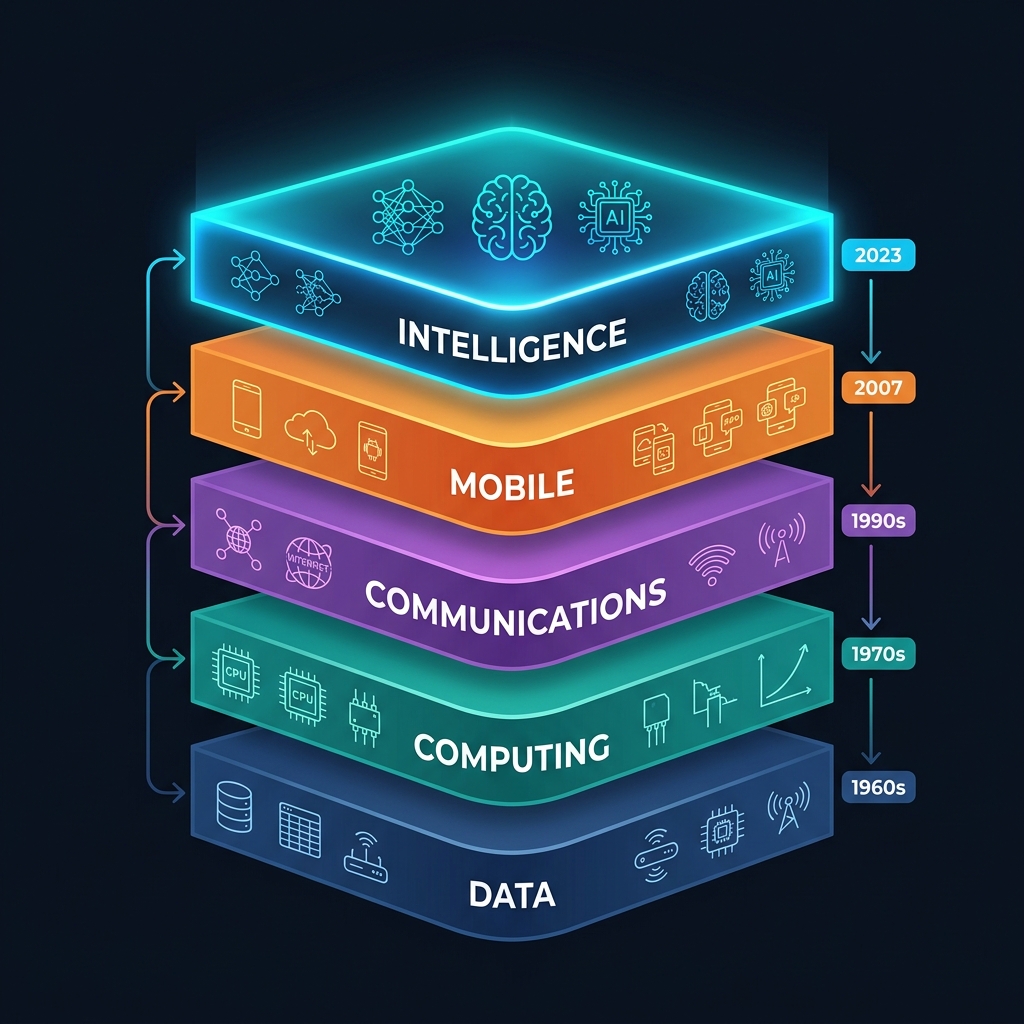
The Stack, Layer by Layer
📊 Layer 1: Data 1960s - Present
Everything starts with data. The Big Data Revolution was the realization that we could collect, store, and organize information at scales previously unimaginable. Sensors, satellites, databases, spreadsheets, government records, medical systems: we built the infrastructure to capture the world in digital form.
Without this layer, nothing above it exists. AI models are only as good as the data they are trained on. The sensors on your satellite, the census records in your GIS database, the patient logs in a hospital system: these are the raw materials of intelligence.
Key Principle
Data is the foundation. Every revolution that followed was, at its core, about making data more accessible, more processable, or more connected.
🔬 Layer 2: Computing 1970s - Present
Data alone is just numbers on tape. The Computing Revolution gave us the machinery to process it. Intel co-founder Gordon Moore observed in 1965 that the number of transistors on a chip doubles roughly every two years, a prediction that held for over five decades. This exponential growth in processing power drove costs down and capability up.
The result? Computers shrank from room-sized mainframes to desktop machines. The Personal Computer Revolution followed: suddenly, individuals had processing power on their desks that rivaled entire university departments a decade earlier. Spreadsheets replaced ledgers. Word processors replaced typewriters. Efficiency gains cascaded across every industry.
🌐 Layer 3: Communications 1990s - Present
Computers were powerful, but they were isolated. Each machine was an island. The Internet Revolution changed that by adding a communications layer. Now machines could talk to each other. Data flowed between systems. A researcher in Strasbourg could access a database in Houston. A student could read a paper published that morning in Tokyo.
This was not just a technical upgrade. It was a paradigm shift. When you connect data and computing through communication networks, you get something qualitatively new: shared knowledge, real-time collaboration, global markets, and the World Wide Web.
📱 Layer 4: Mobile 2007 - Present
The next revolution was not a fundamentally new technology. It was a convergence. When data, computing, and communications were miniaturized and placed in your pocket, everything changed again. The smartphone combined all three layers into a personal, always-connected, location-aware device.
You carried the internet everywhere. You generated data constantly (location, photos, messages, health metrics). You had computing power in your palm. Work, navigation, banking, education: all of it migrated to the mobile form factor.
🧠 Layer 5: Intelligence 2023 - NOW
Now a new layer is being added to the stack. For the first time in the history of computing, we are not adding a layer that stores, processes, transmits, or mobilizes data. We are adding a layer that thinks about it.
Machines that can learn from data. Reason about problems. Generate novel solutions. Write, code, analyze, and create. This is the Intelligence Layer, and it changes the nature of every layer beneath it.
Data is no longer just stored; it is understood. Computing is no longer just calculation; it is reasoning. Communication is no longer just transmission; it is conversation.
"Smart" is Not "Intelligent"
We have used the word "smart" loosely for years. Smartphones. Smart homes. Smart watches. But what does "smart" actually mean in this context? And why is "intelligent" something fundamentally different?
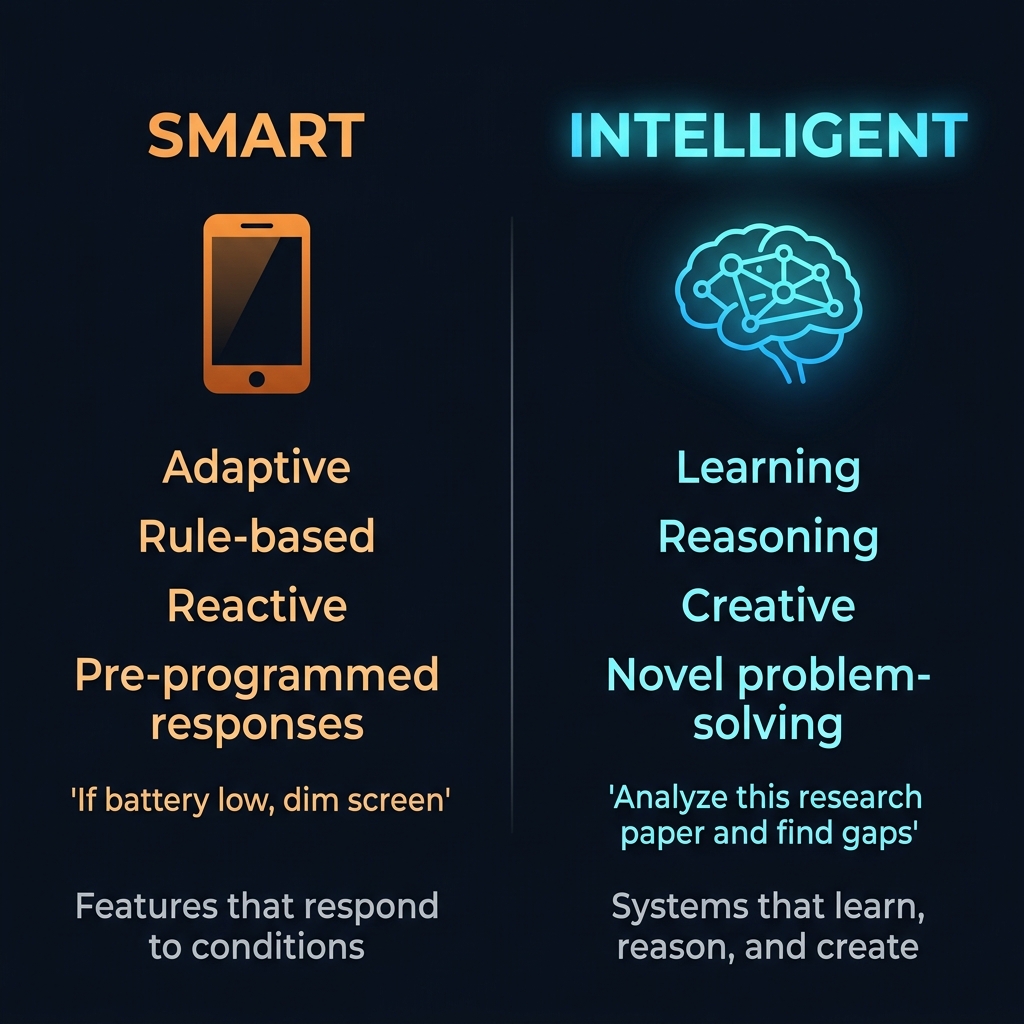
📱 "Smart" (Adaptive)
Definition: A system that adjusts its behavior based on pre-programmed rules and sensor inputs.
- Responds to conditions (if battery low, dim screen)
- Follows decision trees designed by engineers
- Adapts within fixed, human-defined boundaries
- Cannot handle novel situations it was not programmed for
Your "smartphone" was never smart. It was a powerful computer with adaptive features. It followed rules. It did not think.
🧠 "Intelligent" (Reasoning)
Definition: A system that can learn from data, reason about novel problems, and generate solutions it was never explicitly programmed to produce.
- Learns patterns from data without explicit rules
- Reasons through multi-step problems
- Generates novel outputs (text, code, analysis)
- Handles ambiguity, nuance, and context
Intelligence is qualitatively different from smartness. An intelligent system can read a research paper it has never seen and identify gaps in the methodology. No amount of "smart" features can do this.
The Key Insight
The Intelligence Layer is not an incremental upgrade to existing "smart" features. It is a new category of capability being added to the computing stack. Previous revolutions made data more accessible or processable. This revolution makes data understandable.
APIs: Connecting Intelligence to Data
Here is the practical question: if the Intelligence Layer sits at the top of the stack, and Data sits at the bottom, how do they connect?
The answer is APIs (Application Programming Interfaces). APIs are the connective tissue of the computing stack. They are structured endpoints that allow one layer to request services from another.
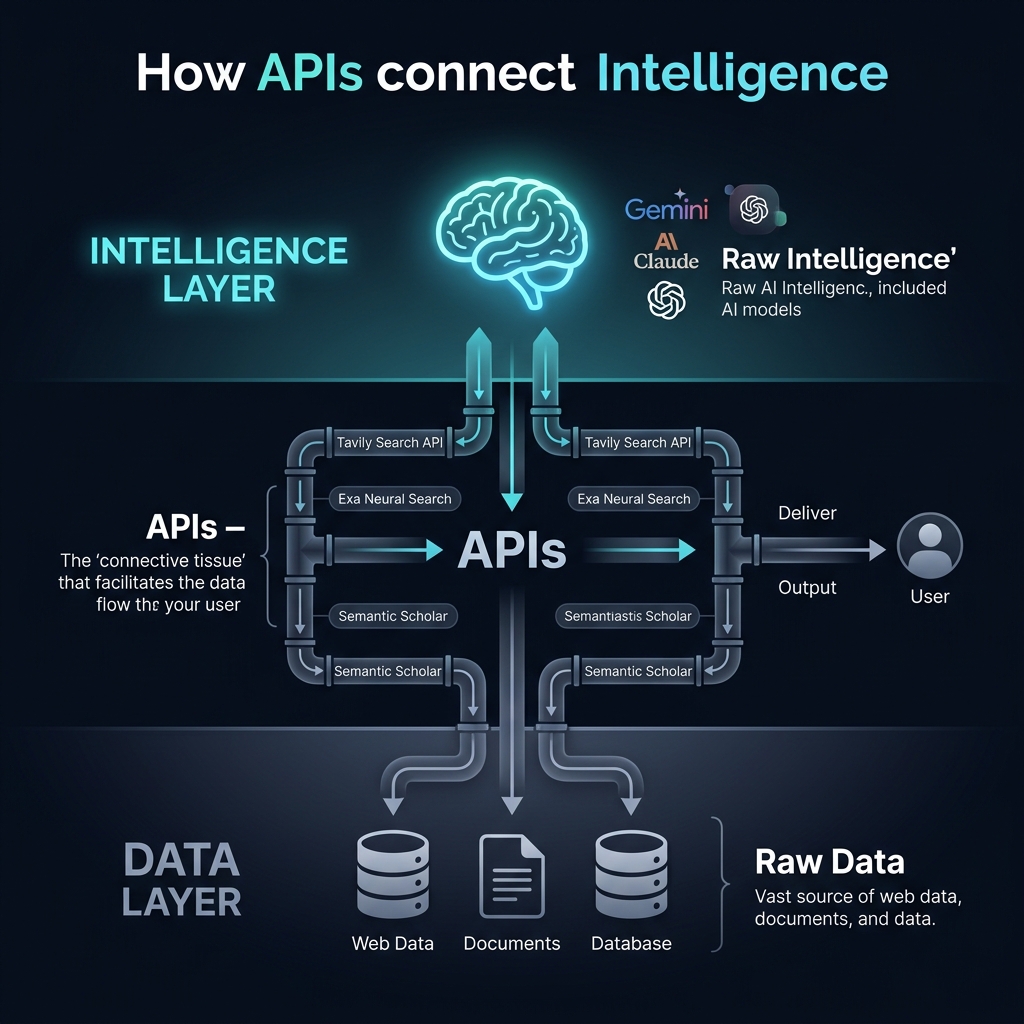
When you build an agentic system, you are essentially wiring the Intelligence Layer to the Data Layer through APIs to deliver something of value to a user.
Example: Building a Research Agent
| Intelligence Layer | Claude, Gemini, or GPT reasons about the research question |
| API Bridge |
Tavily API searches the live web for recent publications Exa API finds semantically related papers Semantic Scholar API retrieves citation graphs |
| Data Layer | Academic databases, web pages, PDF repositories, satellite imagery archives |
This is why we set up API keys in Day 00. Each key unlocks a connection between the Intelligence Layer (your AI agent) and a specific Data Layer (the web, academic literature, or your local files). Without these connections, your agent is intelligent but blind: it can think, but it has nothing to think about.
Systems Thinking Takeaway
When you design an agentic system, you are not just "using AI." You are architecting a stack: choosing which intelligence model sits at the top, which data sources sit at the bottom, and which APIs connect them. The quality of your system depends on how well these layers integrate, not just on how powerful any single layer is.
🧪 Systems Thinking Sandbox
Now it is your turn. Think about a workflow from your own discipline and map it onto the computing stack. Drag components into your stack, pick the LLMs that power the intelligence layer, and save your diagram.