The $500B Question
SpaceX has announced its IPO for June 2026. Blue Origin is expected to follow this summer. Two senior investors, Dr. Sounny and Professor Gaillard, need your team to produce a data-backed market valuation for the offering.
Your deliverable: a static website dashboard hosted on GitHub Pages that presents your final valuation figure, the methodology behind it, and the data that supports your recommendation. The investors will then decide where to allocate capital.
 IPO confirmed: June 2026
 IPO expected: Summer 2026
The Investor Brief
This is not an academic exercise. Read this section carefully. It defines exactly what we expect to see in your pitch.
💰 The Capital Allocation Scenario
Dr. Sounny and Professor Gaillard represent a private investment group holding $500 million in deployable capital. We are considering positions in the upcoming SpaceX and Blue Origin IPOs. However, we have three options on the table:
Your job is to inform this decision. We will not invest based on hype. We invest based on data. Your valuation presentation must give us a clear, defensible number and a recommended entry price. If your analysis is weak, we keep our money in the bank. Worse: you are fired. But if you help us bet well? Big bonuses.
📚 Business 101: What Is an IPO Valuation?
When a company "goes public" through an Initial Public Offering (IPO), it must set a price per share. That price is based on the company's total market valuation (also called market capitalization, or "market cap"). For example, if a company is valued at $200 billion and issues 2 billion shares, each share is priced at $100.
Your task is to estimate what the company is actually worth, independent of hype. If you believe SpaceX is worth $350 billion but the IPO prices it at $400 billion, your recommendation would be: do not buy at that price. If you believe it is worth $350 billion and the IPO prices it at $250 billion, your recommendation would be: buy aggressively, it is undervalued.
📈 Hypothetical IPO Parameters
To produce comparable buy quotes, all teams must use these standardized share counts. These are hypothetical numbers for this exercise:
SpaceX IPO
Blue Origin IPO
The math is simple: Your Market Cap ÷ Shares Outstanding = Your Price Per Share. This is the number you recommend we buy up to. If your valuation says $175/share but the IPO prices at $200, you tell us to wait. If it prices at $140, you tell us to buy aggressively.
📋 Required Deliverables
Every team must present the following in their pitch. These are non-negotiable. Without them, the investors cannot make a decision.
1. Total Market Valuation (Market Cap)
The bottom line number. What is the company worth in US dollars? This is the single most important figure in your entire presentation. State it clearly. Example: "We value SpaceX at $347 billion."
2. Revenue Breakdown
Show us where the money comes from. Break the company's revenue into business segments. For SpaceX, this might be: Starlink (internet), Launch Services (commercial + government), Starship (cargo/crew). For Blue Origin: New Shepard (tourism), New Glenn (launch services), Project Kuiper (internet), Blue Moon (NASA contracts). Use a pie chart or stacked bar chart.
3. Growth Projections (3-5 Year Forecast)
Where is this company going? Show projected revenue growth over the next 3-5 years. Use a line chart. Identify the key growth drivers: is it satellite internet subscribers? Government contracts? Tourism flights? Be specific and cite your data sources.
4. Valuation Methodology
How did you arrive at your number? Common approaches include: Revenue Multiple (comparing to similar public companies, e.g., "Tesla trades at 15x revenue, so we apply 12x to SpaceX"), Discounted Cash Flow (DCF) (projecting future cash flows and discounting to present value), or Comparable Transactions (what have similar companies sold for?). You do not need to be an MBA student to use these; pick one and explain your logic.
5. Recommended Entry Price & Stop Price
Based on your valuation, what is the maximum price per share we should pay? This is your "buy up to" price. If the IPO opens above this number, you are telling us to walk away. Also provide a "stop price": the point at which we should sell if the stock drops after purchase, to limit losses. Example: "Buy up to $185/share. Stop-loss at $155/share."
6. Risk Factors
What could go wrong? Every investment carries risk. Identify at least 3 risks: regulatory (government contracts drying up), technical (launch failures), competitive (new entrants), or financial (cash burn rate). Investors who ignore risk lose money.
7. Final Recommendation
End with a clear call to action: Buy, Hold, or Pass. "Buy" means we should invest at the IPO price. "Hold" means wait for a better entry after market volatility. "Pass" means the company is overvalued and we should put our capital elsewhere. State your conviction level (high, medium, low) and why.
💡 How Investors Actually Decide
Professional investors evaluate pitches on five criteria. We will use the same framework:
- Data Quality: Are your numbers sourced and verifiable? "We think revenue is high" is not data. "$9.8B in projected 2026 Starlink revenue (Morgan Stanley estimate)" is data.
- Logical Coherence: Does your valuation methodology make sense? Do the parts add up to the whole?
- Clarity of Presentation: Can we understand your model in 15 minutes? If your dashboard is confusing, the pitch fails regardless of the data.
- Risk Awareness: Optimism without caution is a red flag. Show us you have thought about what could go wrong.
- Actionable Recommendation: We need a number, a price, and a clear yes/no. Ambiguity is not an investment strategy.
⚠️ Comparability Requirement
All four teams must present their valuation in the same unit: total enterprise value in USD. This allows the investors to directly compare: "Team Alpha says SpaceX is worth $350B. Team Bravo says $280B. Team Charlie says Blue Origin is worth $95B. Team Delta says $140B." Without a comparable number, we cannot allocate capital. If your presentation does not include a clear bottom-line valuation figure, you will be asked to state one before we proceed.
Workshop Schedule
Three hours. Four teams. Two companies. One decision.
📚 Data Analytics Bootcamp
Introduction to data analytics tools within Antigravity. Learn how to leverage AI-assisted research, Chart.js for web visualizations, and GitHub Pages for rapid deployment. Everything stays on free tiers.
🛠️ Build Phase
Teams split up and go to work. Research revenue streams, funding rounds, competitive landscape, and growth projections. Build your valuation model and deploy a static dashboard website using Chart.js and GitHub Pages.
☕ Regroup
Final polish on dashboards. Prepare your 15-minute pitch.
🎧 Investment Pitches
Each team presents their valuation dashboard (15 min each). The investors (Dr. Sounny and Professor Gaillard) challenge your assumptions and data sources. After all four pitches, the investors deliberate and announce their allocation decision.
The Competition
Four teams. Two companies. Only one team walks away with the investment. The investors (Dr. Sounny and Professor Gaillard) will select the team that delivers the most compelling, data-backed pitch.
📜 Team Formation Rules
- Each team must have an equal mix of T1-B (Engineering) and T3-B (Policy/Business/Law) students.
- No team may be composed entirely of one track. The whole point is interdisciplinary analysis.
- Two teams will cover SpaceX, two will cover Blue Origin. You are competing against the other team covering your same company.
- The investors fund one winning team. Make it yours.
Team Alpha
SpaceXBuild your valuation case for the SpaceX IPO. Starlink, launch cadence, Starship economics: tell the investors why your number is right.
Team Bravo
SpaceXSame company, different angle. Compete with Alpha for the best SpaceX valuation. Find what they missed.
Team Charlie
Blue OriginBuild the case for Blue Origin. New Glenn, Project Kuiper, Blue Moon: convince the investors your model holds up.
Team Delta
Blue OriginSame company, rival model. Compete with Charlie. If your pitch is sharper, the investment goes to you.
Your Toolbox
All free-tier. All deployable to GitHub Pages.
💡 Power BI Free Access
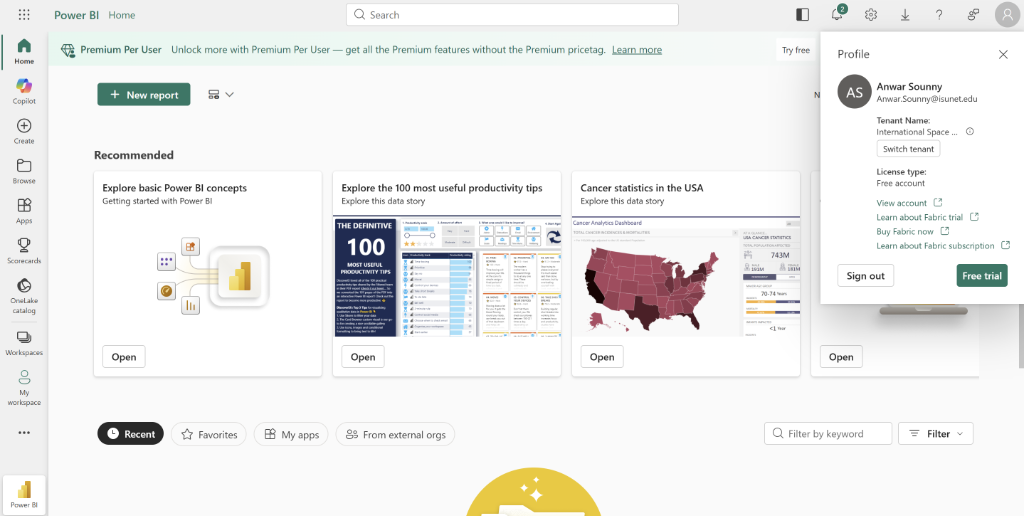
ISU students have free Power BI access. Sign in at app.powerbi.com with your @isunet.edu account. Chart.js is the recommended path for GitHub Pages deployment, but Power BI is available for richer exploratory dashboards.
📊 Tableau Public (Free)
Tableau Public is completely free. Create interactive dashboards with drag-and-drop, then publish to your Tableau Public profile. Great for exploratory visualization.
Launch Vehicle Cost Efficiency
The Investors
Your panel. Convince them.

Dr. Sounny
Resident Faculty, ISUSpecialist in GIS, Remote Sensing, and GeoAI. Values data-driven precision and visual storytelling.

Professor Gaillard
Assistant Professor of Practice, ISUSpace policy and management expert. Will challenge your market assumptions and regulatory risk analysis.