๐Ÿญ Factory 2026 Conference

#Factory2026
L'Orbite

Your pitch day guide. Exhibition, networking, and the moment you present your project to industry leaders, investors, and space professionals.

๐Ÿ“… Thursday, June 11, 2026 ๐Ÿ•™ 12:00 - 19:00 ๐Ÿ“ ISU Campus, Illkirch-Graffenstaden ๐ŸŽค Laureates Pitch: 16:45 (Amphitheatre Galaxy)
Overview

What is Factory 2026?

Factory is the annual industry conference organized by Paddock Academy, with ISU hosting this year's edition. It explores how space and orbital technologies transform health, agriculture, sustainability, and industry. The 2026 edition, themed "L'Orbite", focuses on orbital habitats, Earth observation, and the intersection of space innovation with real-world impact.

This is not a classroom day. Today, the ISU campus becomes a conference venue. Startups, investors, researchers, and industry leaders will fill the halls. You are not just attending; you are exhibiting and presenting.

๐Ÿข
Startup Village
Exhibition tables where startups (and you!) showcase projects
๐ŸŽค
Keynotes & Panels
Industry leaders share insights on space-industry convergence
๐Ÿค
Round Tables
Small group workshops on space applications
๐Ÿท
Networking Cocktail
Post-event drinks and professional connections

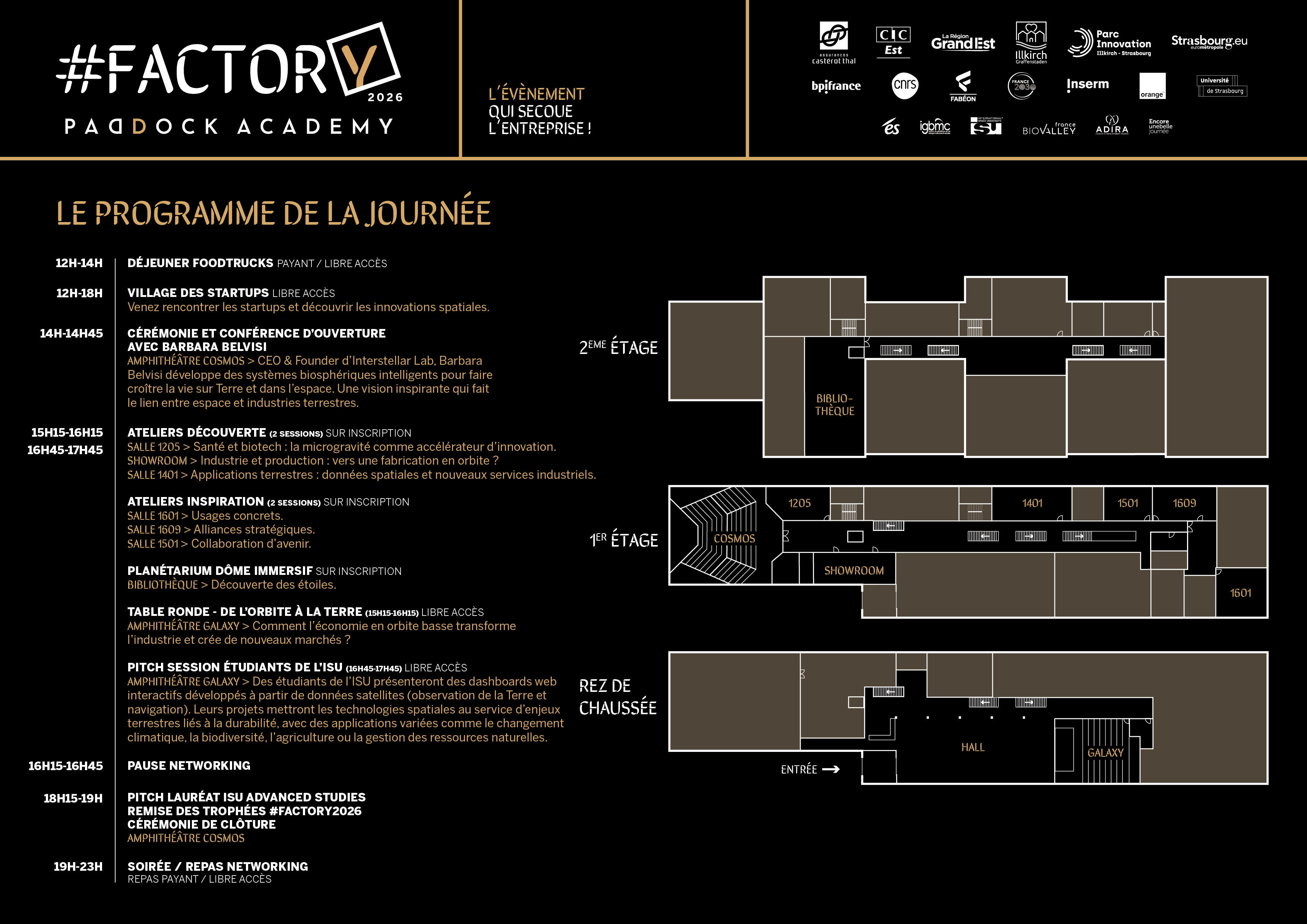
๐Ÿ“… Full Conference Programme

Factory 2026 Programme

Click to expand the official conference schedule and speaker lineup.

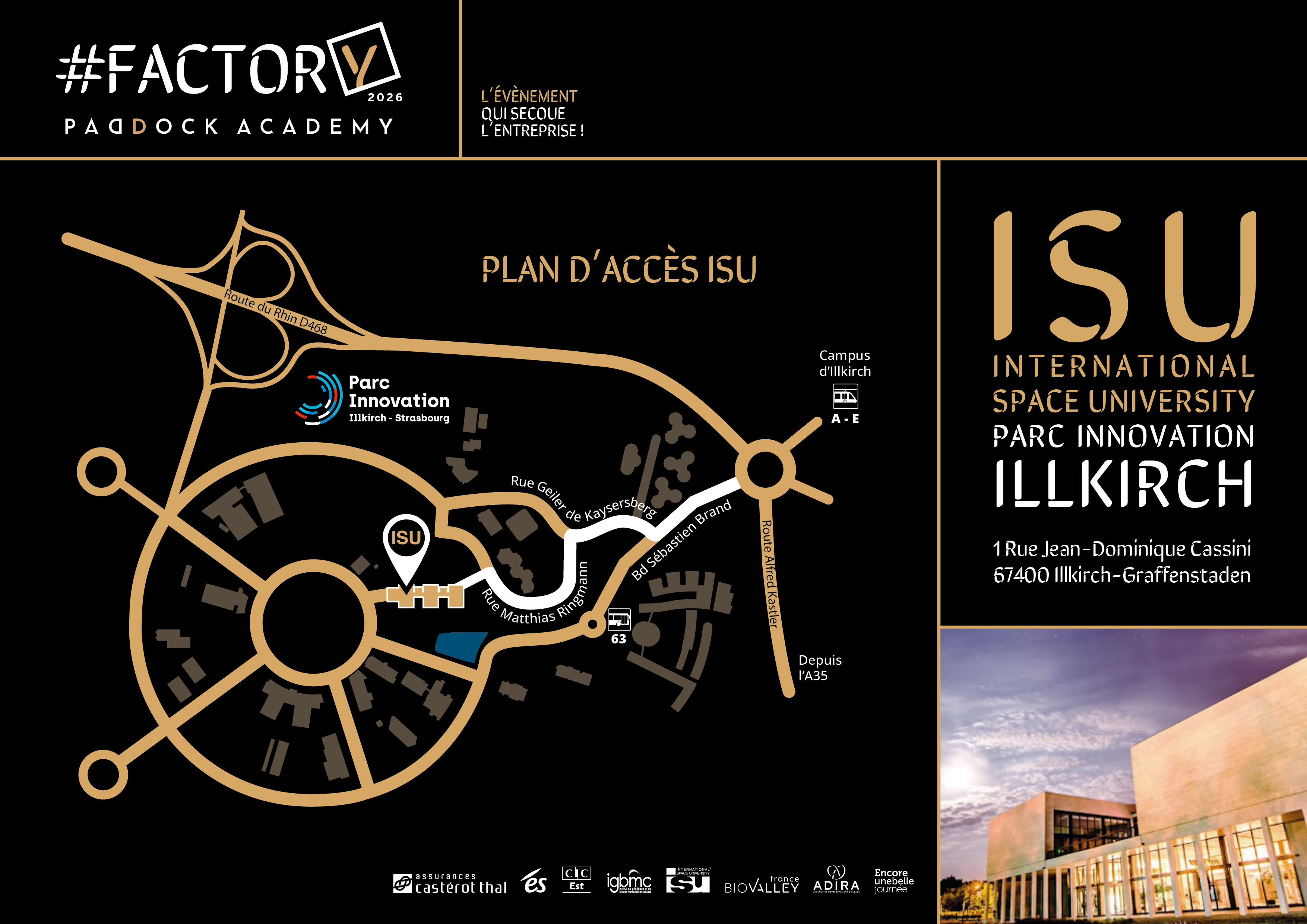
๐Ÿ“ ISU Campus Access Plan

Factory 2026 Access Plan

Click to expand campus pathways and parking coordinates.

Overview

Your Role Today

You have two responsibilities at Factory 2026:

๐Ÿ–ฅ๏ธ

Exhibition Table

Your table is live from 12:00. Attendees will walk around the Startup Village browsing projects. Be ready to explain and demo your work to anyone who stops by.

๐ŸŽค

Laureate Stage Pitch (3 min)

At 16:45, the selected Laureates take the main stage. 3 minutes to present their project to the entire conference. Problem, solution, demo, and a clear ask.

โšก
This is real. The audience includes investors, ESA professionals, startup founders, and ISU alumni. Treat this like a professional presentation. First impressions count.
๐ŸŽฏ
Goal for today: Get at least 3 meaningful contacts (business cards, LinkedIn connections, or emails) from people interested in your project.
ISU Qualifiers

ISU Pitch Qualifiers (10:00 - 12:00)

Before heading to Factory 2026, all teams will pitch their prototypes to the faculty. The strongest teams will advance to the main stage. Be prepared to present your 3-minute pitch and live demo.

  • Laptop fully charged with your demo loaded, tested, and running on localhost or deployed URL
  • 7-minute pitch rehearsed at least 3 times out loud (use a timer!)
  • Exhibition poster or printout summarizing your project (A3 minimum, or laptop screen with slides)
  • Device for live demo at your table (tablet, second laptop, or phone)
  • QR code printed linking to your project URL, portfolio, or LinkedIn profile
  • Business cards or digital contact sharing ready (LinkedIn QR works great)
  • Backup plan if WiFi fails: screenshots, offline mode, or a video recording of your demo
  • Professional appearance: dress business casual at minimum
ISU Qualifiers

Setting Up Your Exhibition Table

Your table is your storefront. Here is how to arrange it for maximum impact:

Recommended Table Layout
๐Ÿ“‹
Print Materials
Poster, QR code, business cards
๐Ÿ’ป
Live Demo (Center)
Laptop angled toward visitors, demo running
๐Ÿ“ฑ
Secondary Screen
Phone/tablet with project video or slides
โ† Visitor approach side โ†’

Table Tips

  • Stand, do not sit. Standing signals that you are open and ready to engage.
  • Eye contact first. Smile and greet people as they approach, even before they ask.
  • 30-second elevator pitch ready for casual walk-by visitors (shorter than your stage pitch).
  • Keep the table clean. No food wrappers, no phone scrolling, no clutter.
๐Ÿ”ฅ
Your table is live from 12:00. Attendees will come by at any time. Have at least one team member at the table at all times during the exhibition period.
ISU Qualifiers

Your 7-Minute Pitch Structure

Selected teams have exactly 7 minutes on stage in the PIB format. Every second counts. Here is the recommended structure:

1
minute
๐Ÿ”ด Problem
State the pain point with a specific, vivid statistic or story
2
minutes
๐Ÿ’ก Solution
What you built, how it works, and why it is unique
3
minutes
๐Ÿ–ฅ๏ธ Demo
Show the working product live. Click through the key feature.
1
minute
๐ŸŽฏ The Ask
What do you need? Data? Partners? Funding? Feedback?
โฑ๏ธ
Practice tip: Record yourself on your phone. Watch it back. You will catch filler words, awkward pauses, and timing issues immediately. Do this at least twice this morning.
โš ๏ธ
Common mistake: Spending 2 minutes on the problem and only 30 seconds on the demo. Flip it. The demo is your strongest asset. Let people see the product.
Quiz

Quick Check: Pitch Preparation

You have 7 minutes on stage. Your demo crashed right before your slot. What is the BEST course of action?

A Skip the demo section entirely and use the extra 60 seconds to explain more about the problem
B Try to fix the demo live on stage while narrating what you are doing
C Switch to your backup: show pre-recorded screenshots or a video of the demo, and narrate the walkthrough
D Ask to be moved to a later time slot so you can fix the issue
โœ… Correct! Always have a backup plan. Screenshots, a screen recording, or even a well-narrated slide deck can save your pitch. This is exactly why your checklist includes a backup plan item. Professionals never rely on a single demo path.
โŒ Not quite. The best approach is C: switch to your backup screenshots or video. Never debug live on stage, and never skip the demo entirely. Always prepare a backup (screen recording, screenshots, or pre-made video).
Schedule

Factory 2026: Full Day Timeline

10:00 - 12:00
ISU Pitch Qualifiers
All teams present 3-minute pitches to faculty. Strongest teams advance to the main stage.
12:00
Doors Open
Startup Village & Exhibition goes live. Food trucks on-site.
12:00 - 14:00
Networking & Exhibition Browsing
Attendees circulate through exhibition. Engage visitors at your table.
14:00 - 15:00
๐ŸŽค Opening Ceremony
Keynote by Franรงoise Pierrot (European Space Affairs Office, Prime Minister's Office)
15:15 - 16:15
๐ŸŒ TERRA Workshop (Salle 1401)
Dr. Sounny leads the TERRA horizon project workshop. Interactive demos for Greece, Poland, Scotland.
16:15 - 16:45
โ˜• Coffee Break
Refreshments and transition to Amphithรฉรขtre Galaxy.
16:45 - 17:45
๐Ÿš€ Laureates Pitch (Amphitheatre Galaxy)
Selected teams present to the full conference audience.
17:45+
๐Ÿท Closing Ceremony & VIP Networking Cocktail
Trophies, student business simulation pitches, and VIP evening.
Schedule

Afternoon Highlights

๐ŸŽค Opening Keynote: Franรงoise Pierrot (14:00 - 15:00)

Franรงoise Pierrot represents the European Space Affairs Office at the Prime Minister's Office (and formerly CNES). Her opening ceremony keynote sets the stage for the commercial and public convergence of space technologies.

๐Ÿ’ก
Why this matters to you: If your project involves agriculture, food security, or environmental monitoring, pay close attention. This talk connects directly to EO use cases for crop health and land-use analysis.

๐Ÿค Round Tables (15:00 - 16:00)

Multiple parallel workshops running simultaneously. Topics include: satellite data for disaster management, commercial EO market trends, AI-driven analytics for sustainable development, and space-industry partnerships.

Strategy: Attend the round table most relevant to your project. Take notes and collect contacts from panelists. These are potential mentors, advisors, or data providers.

๐ŸŒŸ
Gold Standard Example: Look to the Valencia Flood Crisis project (by Grazia Testa and Michael Cebral Lopez). They successfully used Copernicus Sentinel-1 and Sentinel-2 imagery for crisis management and collective action tracking. Their project was vetted by Innovation Managers at ร‰S and serves as a benchmark for connecting EO data to real-world problems.
๐Ÿ“
Networking tip: Prepare 2 questions in advance for the round table discussion. People remember those who ask thoughtful questions.
Schedule

๐ŸŒ TERRA Workshop: AI + Digital Twins for EO

Workshop Lead: Dr. Sounny
Time: 15:15 - 16:15
Location: Salle 1401
Format: Interactive demo across 3 regional tables (Greece, Poland, Scotland) with real-time AI translation

This workshop presents the TERRA framework: using AI agents combined with digital twin technology to create living, queryable models of Earth systems. Attendees will see how satellite data pipelines feed into AI-powered analysis that can answer natural-language questions about environmental change.

Topics Covered

  • Building AI agents that autonomously query satellite APIs
  • Digital twin concepts applied to Earth observation
  • Real-time NDVI analysis with natural language interfaces
  • From prototype to production: lessons from ISU student projects
๐Ÿ›ฐ๏ธ
Satellite Data
Sentinel, Landsat, MODIS
๐Ÿง 
AI Agents
LLM + Tool Use
๐ŸŒ
Digital Twins
Living Earth Models
๐ŸŽ“
Your projects will be referenced during this workshop as examples of what ISU students can build. This is additional visibility for your work.
Pitch Time

๐Ÿš€ Laureates Pitch Slot (Amphitheatre Galaxy)

Countdown to Pitch
--:--:--
Laureates Pitch Presentations begin at 16:45 CET

What to Expect

๐ŸŽฏ
Before you go on stage: Take a breath. Smile. Remember: you built something real. You know it better than anyone in the room. Own it.
๐Ÿ“ฑ
Tech check: Test your demo on the projector during the 15:00 break. Confirm HDMI connectivity, screen resolution, and audio (if applicable). Do not leave this to the last minute.
Schedule

Venue Logistics & Practical Info

๐Ÿ“ Location

ISU Campus
1 Rue Jean-Dominique Cassini
67400 Illkirch-Graffenstaden
Strasbourg, France

๐ŸŒ WiFi

Network: ISU-Factory2026
Password: will be provided on-site

Have your demo's offline backup ready in case of congestion.

๐Ÿฝ๏ธ Food & Drinks

Lunch buffet available 12:00-14:00
Coffee stations throughout the day
Networking cocktail 17:45-19:00

๐Ÿ”Œ Power & AV

Power strips at each exhibition table
Main stage: HDMI + USB-C adapters
Bring your own charger and adapter

๐Ÿ”‹
Battery alert: Your laptop will be running demos all day. Bring your charger. If you have a power bank for your phone, bring that too.
Pitch Tips

The Golden Rules of Pitching

Whether you are pitching to investors, industry experts, or potential partners, these rules will make the difference:

1
Lead with the problem, not the technology. Nobody cares about your tech stack until they understand the pain you are solving. Start with a story, a statistic, or a question that makes the audience feel the problem.
2
Show a live demo if at all possible. A working prototype is worth a thousand slides. Even a simple demo proves you can execute. If live is too risky, use a pre-recorded video with your narration.
3
Be specific. Say "25% of arable land in sub-Saharan Africa faces degradation," not "there is a problem with farming." Numbers make your case credible and memorable.
4
Make a clear ask. What do you need? Feedback? Data access? A partnership? Investment? An unclear ask means the audience does not know how to help you, even if they want to.
5
Smile and make eye contact. Confidence is contagious. Look at the audience, not at your screen. Rehearse enough that you do not need to read your notes.
๐ŸŒŸ
Gold Standard Example: Look to the Valencia Flood Crisis project (by Grazia Testa and Michael Cebral Lopez). They successfully used Copernicus Sentinel-1 and Sentinel-2 imagery for crisis management and collective action tracking. Their project was vetted by Innovation Managers at ร‰S and serves as a benchmark for connecting EO data to real-world problems.
Pitch Tips

What Investors and Experts Look For

Even if you are not seeking funding today, understanding the investor mindset will sharpen your pitch and help you communicate more effectively.

๐Ÿ“Š
Market Size
How big is the problem? Who are the potential users or customers? Is this a growing market?
๐Ÿ‘ฅ
Team Capability
Can this team actually build this? What unique skills or domain expertise do you bring?
๐Ÿ’ก
Innovation
What is new here? Why has nobody done this before? What is your unfair advantage?
๐Ÿ“ˆ
Scalability
Can this grow beyond the prototype? Is the technology architecture built to scale?

After Your Pitch: The Follow-Up

๐Ÿค
Remember: The pitch is not the end; it is the beginning of a conversation. The real value comes from the relationships you build today.
Quiz

Quick Check: The Investor Lens

An investor asks: "What happens if a competitor builds this same tool next year?" Which response demonstrates the strongest pitch awareness?

A "We do not really have competitors right now, so we are not worried about it."
B "Our technology is so advanced that nobody could replicate it."
C "Our advantage is our domain-specific training data and the partnerships we have already established with local agricultural cooperatives. Those relationships take years to build."
D "We would pivot to a different market segment."
โœ… Excellent! This answer shows a mature understanding of competitive advantage. Investors call this a "moat": a defensible position that is hard for competitors to replicate. Proprietary data, established partnerships, and domain expertise are strong moats.
โŒ Not the best answer. The strongest response is C. It identifies a concrete, defensible advantage (proprietary data + established partnerships) rather than being dismissive, overconfident, or avoidant. Investors want to hear about your "moat."
Post-Conference

After Your Pitch: Making It Count

The pitch is just 3 minutes. What you do in the hours and days after determines whether today creates lasting impact.

Step 1
๐Ÿ“
Capture Feedback
Write down every piece of feedback tonight. Questions asked, suggestions made, criticisms received. Fresh notes are invaluable.
Step 2
๐Ÿ“ง
Follow Up (24h)
Send personalized emails to every meaningful contact. Attach your pitch deck. Reference your conversation specifically.
Step 3
๐Ÿ”„
Update Your Project
Incorporate the best feedback into your project. This directly feeds into tomorrow's build sprint (Day 5).

Dealing With Feedback

You will receive a range of reactions. Here is how to process them:

๐Ÿ”ฎ
Tomorrow (Day 5): We transition from pitching to building. The feedback you collect today becomes the requirements list for your next development sprint. Come prepared to iterate.
Summary

Summary of Big Ideas

๐Ÿญ
Factory 2026 is your real-world stage. This is not a simulation. Real investors, real professionals, real feedback. Treat every interaction as a professional opportunity.
๐ŸŽค
Preparation is everything. Your 7-minute pitch has been rehearsed, your table is set up, your backup plan is ready. Professionals make it look easy because they prepared thoroughly.
๐Ÿ–ฅ๏ธ
Show, do not tell. A working demo is your strongest argument. Lead with the product. Let the technology speak for itself, then explain the science behind it.
๐Ÿค
Networking is a skill, not an accident. Have your 30-second and 7-minute pitches ready. Exchange contacts proactively. Follow up within 24 hours.
๐Ÿ”„
Feedback fuels iteration. Capture every piece of feedback. The best ideas for your next sprint will come from the questions and critiques you receive today.
๐ŸŒŸ
You built something real. In just 4 days, you went from concept to a working prototype that you are now presenting to industry professionals. That is exceptional. Be proud, be confident, and enjoy the moment.
Reference

Glossary of Key Terms

Pitch
A concise, persuasive presentation of a project or business idea, typically 1 to 5 minutes, designed to generate interest, support, or investment from an audience.
MVP (Minimum Viable Product)
The simplest version of a product that can be released to test a business hypothesis. It includes only the core features needed to validate demand with real users.
Value Proposition
A clear statement of how your product solves a customer's problem, delivers specific benefits, and differentiates itself from alternatives. The core of any effective pitch.
Exhibition
A public display where teams or companies showcase their work at assigned tables or booths, allowing attendees to browse, ask questions, and interact with demos.
Networking
The practice of building professional relationships through conversation, contact exchange, and follow-up. A deliberate skill, not just socializing.
Investor
An individual or organization that provides capital to a business in exchange for equity, returns, or strategic partnership. At Factory 2026: VCs, angel investors, and corporate scouts.
Startup Village
A dedicated exhibition area at a conference where early-stage companies and student teams display prototypes and engage with visitors, investors, and potential partners.
Moat
A competitive advantage that is difficult for others to replicate. Examples: proprietary data, exclusive partnerships, patented technology, or strong brand recognition.
Digital Twin
A virtual replica of a physical system (like a crop field or urban area) that is continuously updated with real-world data (e.g., satellite imagery) and can be queried or simulated.
๐ŸŒŸ Pioneer Profile
๐Ÿ‘ค

Gwynne Shotwell

President & COO, SpaceX

She has been instrumental in the commercial success of SpaceX, mastering the art of the aerospace pitch and commercial negotiation.

๐ŸŒ Local to Global

Pitching Space Tech to Terrestrial Industries

Applying EO to Community Challenges

At Factory 2026, the goal is bridging the gap. Startups must show how orbital technology solves down-to-earth problems like supply chain logistics.

๐Ÿ“
Texas Connection: In Texas, EO data is used to monitor the Edwards Aquifer depletion and track the expansion of urban heat islands across the Dallas-Fort Worth metroplex.
๐Ÿ—บ๏ธ
๐Ÿค” Geographic Inquiry

Regional Decisions Scenario

Scenario: Sustainable Workspace Siting

Your startup needs to establish a new hybrid work hub. You must balance employee commute times, environmental impact (using the IPAT equation), and existing green infrastructure.

Your Task:

  • Identify 3 potential sites using EO vegetation indices.
  • Calculate the estimated carbon footprint of hybrid commuting.
  • Propose a Placemaking strategy for the hub.
๐Ÿ“š Summary

Big Ideas & Glossary

Summary of Big Ideas

  • Data is only as valuable as its application.
  • Space technology has direct terrestrial benefits.

Glossary of Terms

Earth Observation
Gathering information about Earth via remote sensing.
๐Ÿ“ Knowledge Check

Auto-Graded Quiz

What is the most important element of a successful startup pitch at Factory 2026?
A
Listing every technical specification of your satellite
B
Clearly communicating the terrestrial problem you are solving and your business model
C
Using the most expensive presentation software
โœ… Correct! Investors at Factory 2026 are looking for commercial viability and clear problem-solving, not just deep technical specs.
โŒ Incorrect. The right answer was B. Investors at Factory 2026 are looking for commercial viability and clear problem-solving, not just deep technical specs.

๐Ÿ“ Daily Reflection

What was your biggest takeaway from this session, and how does it apply to the TERRA project? Write your response below. Your instructor will review this to track your progress.