Chapter 04

GNSS & Positioning

Positioning on Earth. Discover the science behind Global Navigation Satellite Systems and the methods for achieving high-precision positioning across the globe.

At a Glance

Prereqs: Chapter 03 Time: 20 min read + 20 min practice Deliverable: Field collection plan

Learning outcomes

  • Explain how GNSS positioning works at a high level.
  • Identify factors that reduce accuracy (multipath, poor geometry).
  • Plan a basic field collection workflow for validation/GCPs.

Key terms

GNSS, trilateration, multipath, DOP, differential correction, datum

Stop & check

  1. What usually causes multipath error?

    Answer: Signals reflecting off buildings/terrain before reaching the receiver.

    Why: Reflections increase path length and bias the range estimate.

    Common misconception: More satellites always guarantees better accuracy; geometry and environment matter.

  2. Why does CRS/datum matter for GNSS points?

    Answer: Because coordinates depend on the reference model used.

    Why: A mismatch can create consistent offsets between layers.

    Common misconception: Latitude/longitude is universal and automatically matches every map.

Try it (5 minutes)

  1. List 3 places on campus/city where GNSS accuracy would likely be poor.
  2. For each, write one mitigation (move, wait, repeat, use correction).

Lab (Two Tracks)

Both tracks produce the same deliverable: a one-page plan describing the collection of validation points for an imagery analysis.

Desktop GIS Track (ArcGIS Pro / QGIS)

Design a point feature class or form schema (fields + domains). Define required metadata (time, accuracy, notes).

Remote Sensing Track (Google Earth Engine)

Define an AOI and draft a validation sampling plan (how many points per class and where you would collect them).

Common mistakes

  • Collecting points with unknown CRS/datum or missing metadata.
  • Taking one reading and assuming it is correct (no repeats).
  • Collecting under tree canopy/near buildings without noting expected error.

Further reading: https://gistbok-ltb.ucgis.org/

What is GNSS?

GNSS (Global Navigation Satellite System) is the umbrella term for satellite constellations that provide positioning, navigation, and timing (PNT) data. While GPS (Global Positioning System) is the most famous, it is actually just one of several systems operated worldwide. For official US government information, visit GPS.gov.

System Country Status
GPSUSAGlobal
GLONASSRussiaGlobal
GalileoEuropean UnionGlobal
BeiDouChinaGlobal

The Three Segments

  • Space Segment: The constellation of satellites broadcasting signals.
  • Control Segment: Ground stations that track satellites and upload orbital corrections.
  • User Segment: A receiver (phone, car, survey gear) that calculates the position.

⚠️ Why is GPS Inaccurate?

Standard smartphone GPS is accurate to about 4.9 meters (16 ft). Why isn't it perfect? The signal travels 20,000 km and faces several hurdles:

1. Ionospheric Delay: Charged particles in the upper atmosphere slow down the radio waves. This is the biggest source of error.
2. Multipath: In cities, signals bounce off glass buildings before hitting your phone. Your device thinks the satellite is further away than it is, causing your "blue dot" to jump across the street.
3. Geometry (PDOP): If all visible satellites are clustered in one part of the sky, the triangulation is weak (high Dilution of Precision). You want them spread out.

🏙️ The "Urban Canyon" Problem

When you're in a narrow canyon—natural or urban—buildings or cliffs block large portions of the sky. Your GPS receiver may still get a position fix, but all the visible satellites come from the same narrow slice of sky, creating terrible geometry.
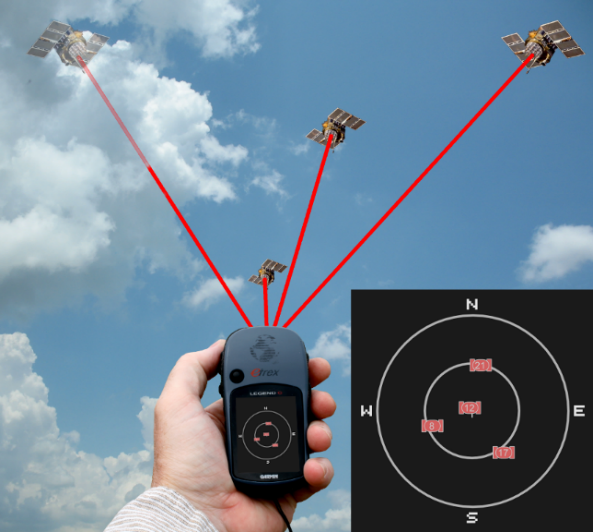
GPS receiver in canyon with limited sky view - satellites clustered in visible sky portion

Limited Sky View: In a canyon, only a small portion of the sky is visible. All available satellites are clustered in this narrow window, leading to poor PDOP values.
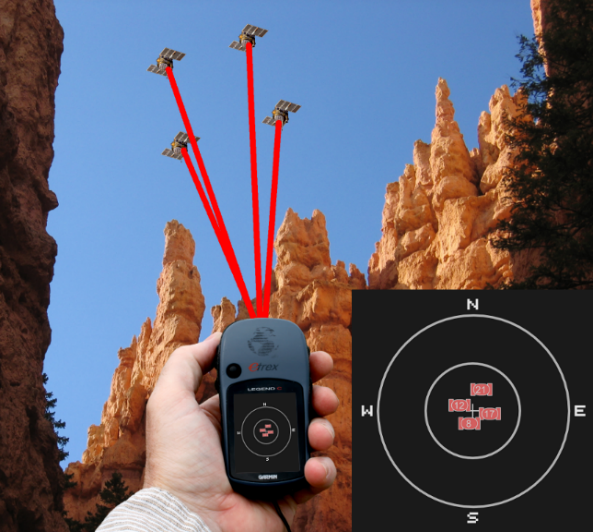
Effect of poor satellite geometry on GPS accuracy

Poor Geometry = Poor Accuracy: Even though you may lock onto 4+ satellites, if they're all from the same part of the sky, the trilateration "intersection zone" becomes elongated and uncertain.

💡 Real-World Example: This is why your phone's GPS often struggles in downtown Houston or Austin—the tall buildings create artificial canyons that limit sky visibility, just like being at the bottom of a natural canyon in Big Bend.

The 20-Minute Gap: Autonomy vs. Control

In GIS, we are used to real-time data. Google Maps updates traffic instantly. But deep space reintroduces the Time Lag.

The "Mars Delay": It takes up to 20 minutes for a radio signal to reach Mars. That means a 40-minute round trip for a "Yes/No" question.

"We can't rely on 'Ground Control' to read the test results. The device must be autonomous."

This forces a shift from Remote Control (Earth driving the rover) to Edge Computing (the rover driving itself). In the future of GIS, our sensors must be smart enough to analyze data before sending it home.

Accuracy Visualizer

Reading satellite signals in real-time...

Accuracy: ±2.5m

🎯 The Quest for the Centimeter (RTK)

For navigation, 5 meters is fine. For building a bridge, it is disastrous. Engineers use Real-Time Kinematic (RTK) to achieve 1 cm accuracy.

How it works:

  1. Base Station: A receiver sits on a known coordinate and never moves. It calculates exactly how much the atmosphere is delaying the signal right now.
  2. Correction Signal: It broadcasts this "correction" via radio or internet.
  3. Rover: The mobile unit applies the correction instantly, removing the error.

Interactive: Trilateration Simulator

Drag the 3 satellites to see how their signal spheres overlap to pinpoint a location. Notice how poor geometry (satellites in a line) creates a larger area of uncertainty.

Drag the satellites (🛰️)!

How Trilateration Works

The core math behind GPS is Trilateration. It's like a high-tech version of triangulation, but using spheres instead of triangles.
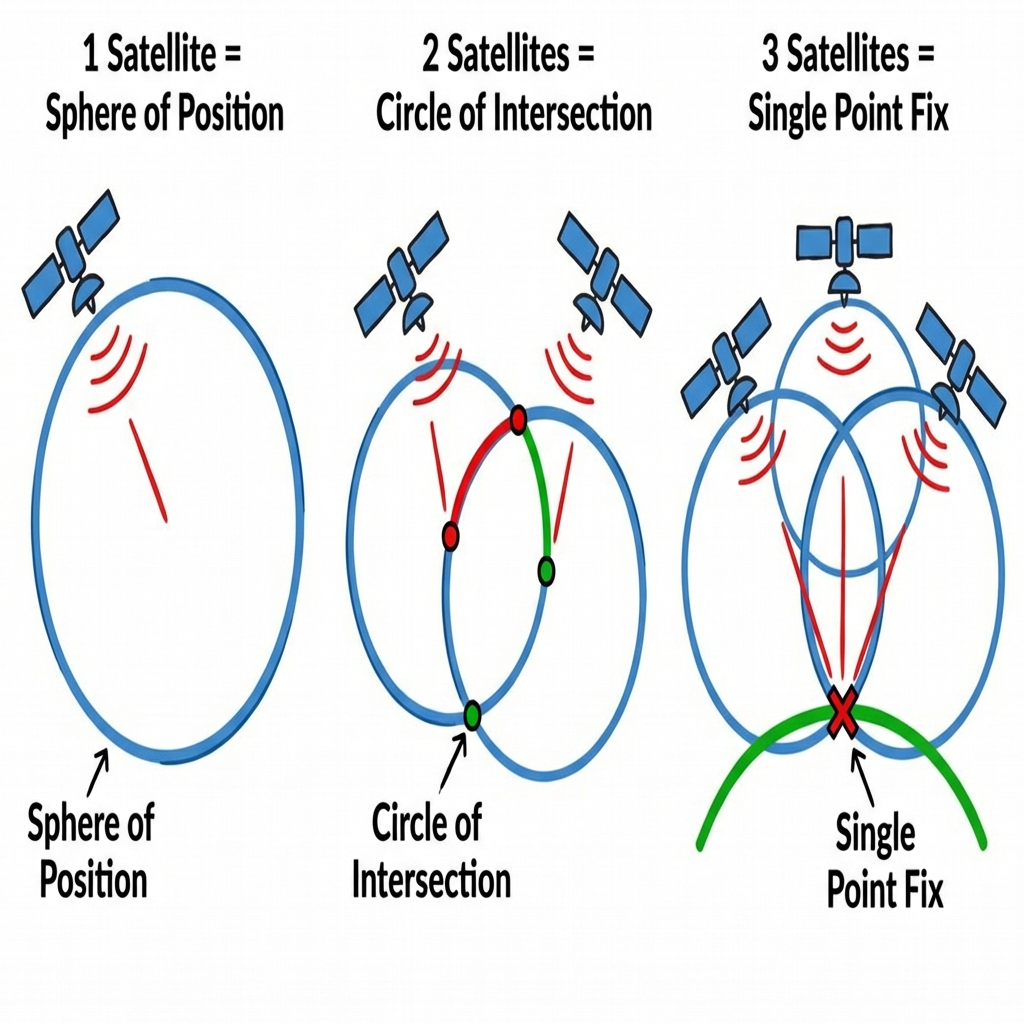
GPS Trilateration Diagram
  1. 1 Satellite: The location exists on a sphere of radius $R_1$ from the satellite.
  2. 2 Satellites: The intersection of two spheres is a circle. The location exists on that circle.
  3. 3 Satellites: The intersection of the circle and a third sphere narrows it down to two points. One is usually way out in space, the other is on Earth.
  4. 4 Satellites: The fourth sphere resolves the ambiguity and corrects for time bias in the receiver's clock. TV + 3D Position.
🛑 Ethics: The "Strava" Problem

GPS creates a digital trail of your life. In 2018, the fitness app Strava released a "Heatmap" of user runs. It inadvertently revealed secret US military bases because soldiers were tracking their jogs around the perimeter. Location Privacy is a massive ethical issue in GIS.

⚠️ The Billion-Dollar Typo: The Negative Sign

Computers hate Degrees/Minutes/Seconds (DMS). They want Decimal Degrees (DD).

The Conversion Math

DD = Degrees + (Minutes/60) + (Seconds/3600)

Simple, right? You do the math, you get 97.51°.

The Trap

If you upload 97.51, 30.26 to a GIS, you will land in China.

The Rule: The Western Hemisphere (North & South America) is NEGATIVE Longitude.
The Southern Hemisphere is NEGATIVE Latitude.

You must manually add the (-). The calculator won't do it for you!

Correct Coordinate: -97.51, 30.26 (Austin, Texas)

Summary of Big Ideas

  • Trilateration: The mathematical process of finding the location by measuring distances to 4 or more satellites.
  • Differential GPS (DGPS): Using a stationary base station at a known point to correct errors for a mobile receiver.
  • DOP (Dilution of Precision): A measure of how much the satellite geometry (positions) affects positioning accuracy.
  • Error Sources: Atmospheric delays, signal multipath (bouncing off buildings), and orbital drift.

Chapter 4 Checkpoint

1. How many satellites are required to determine a 3D position (Lat, Lon, Alt) + Time?

3 Satellites
4 Satellites

2. Which component is responsible for uploading clock and orbital corrections to the satellites?

Space Segment
Control Segment

Chapter Glossary

GNSS (Global Navigation Satellite System) The general umbrella term for all satellite navigation constellations, including GPS (USA), Galileo (EU), GLONASS (Russia), and BeiDou (China).
Multipath Error A positioning error caused when satellite signals reflect off buildings or terrain before hitting the receiver, artificially extending the signal path.
Trilateration The mathematical method used by GPS receivers to calculate position by measuring distances to at least four satellites.
← Chapter 3: Projections Chapter 05: Digitizing Vector Data →

BoK Alignment

Topics in the UCGIS GIS&T Body of Knowledge that support this chapter.